
Classic retargeting — “show a banner to everyone who visited the website” — is almost dead. Not because repeated touchpoints no longer work. On the contrary: they have become more expensive, smarter, and more demanding in terms of data. The problem is that many businesses still operate with a 2018 mindset: collect an audience of visitors, launch banners, increase frequency, and wait for sales.
In reality, the customer has not moved in a straight line for a long time. They may see a product on YouTube, compare the price in Search, postpone the purchase, return through Gmail, click Shopping, and then buy after a branded query. And if you do not have proper first-party data, correct events, conversion values, and customer segmentation, Performance Max will simply optimize “somehow.” And “somehow” in paid advertising usually means expensive.
In this article, we will break down how to use retargeting and Performance Max not for cosmetic warming up, but as a system for bringing back “dormant” customers, increasing repeat sales, and growing LTV. No magic, no “secret buttons,” but with mechanics that genuinely make sense inside Google Ads accounts in 2025–2026.
Why retargeting in 2025–2026 no longer works “the old way”
Previously, retargeting was simple: install a tag, collect all website visitors, and chase them with banners. It worked because competition was lower, cookies were more stable, and advertising systems had more direct signals about user behavior.
Now everything is different. Browsers restrict tracking, users more often refuse cookie consent, the path to purchase has become longer, and Google is increasingly moving optimization into AI models. Performance Max is not just another campaign type. It is a campaign that works across Google’s entire inventory ecosystem: Search, YouTube, Display, Discover, Gmail, Maps, and Shopping. Google itself describes Performance Max as a goal-based campaign type that gives access to all Google advertising inventory from a single campaign.
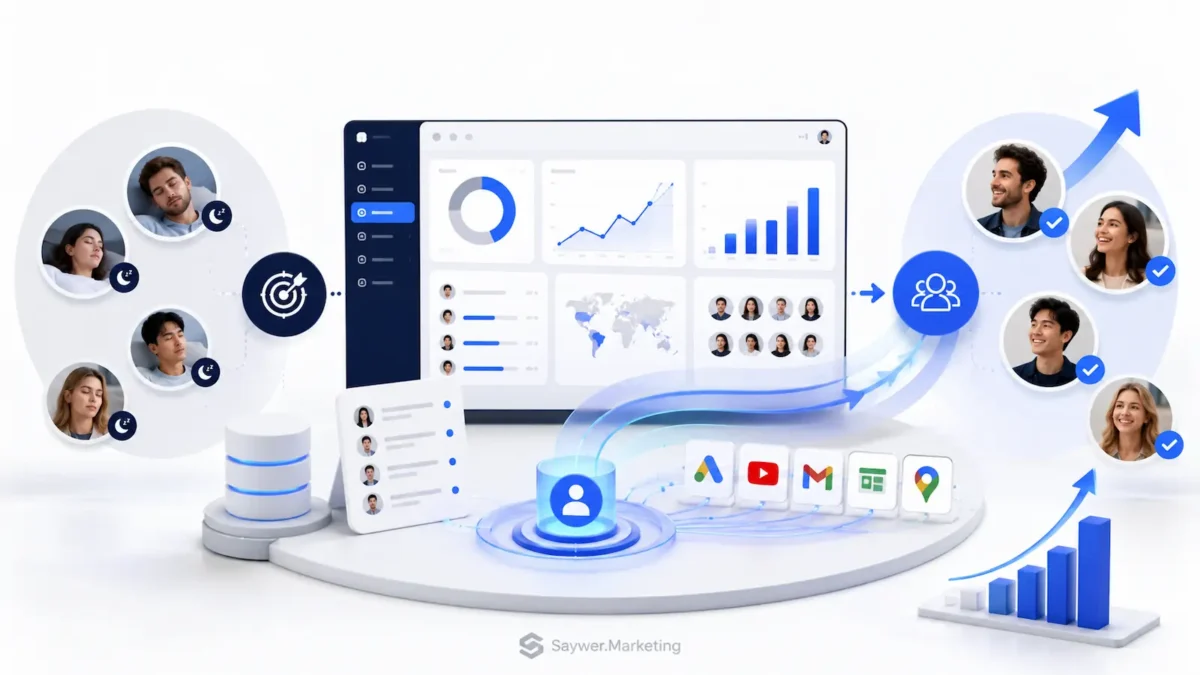
Customer Match is becoming especially important. It allows you to use your own online and offline data to re-engage customers across Search, Shopping, Gmail, YouTube, and Display. In other words, a database of emails, phone numbers, CRM segments, and buyers stops being just “a spreadsheet in CRM” — it becomes fuel for the advertising algorithm.
What role Performance Max plays in bringing back “dormant” customers
Performance Max is not powerful because it “does everything by itself.” That is a dangerous myth. Its power lies elsewhere: if you give the system the right goals, quality data, audience segments, and enough creatives, it can find touchpoints where manual control simply cannot keep up.
For bringing back “dormant” customers, PMax is interesting for three reasons:
1. Full channel coverage
One customer responds better to YouTube, another to Shopping, and a third returns through branded search. Performance Max can work with all these touchpoints at the same time.
2. Optimization for value
If you pass revenue, margin, or at least different conversion values, the algorithm can search not just for cheap purchases, but for more valuable repeat orders.
3. Work with lifecycle goals
Google Ads is developing customer lifecycle goals, including modes for acquiring new customers and re-engaging those who have stopped buying.
Important point: PMax is not a replacement for strategy. If the business does not clearly understand exactly whom to bring back, after what period, with what offer, and at what acceptable cost of a repeat sale, the campaign will not save the situation. It will simply scale chaos.
What data is needed for effective reactivation
Customer return starts not in the ad account, but with data. And this is where many businesses painfully face reality: the database exists, but it is dirty; purchases exist, but without margin; leads exist, but it is unclear which of them became sales; CRM exists, but Google Ads knows nothing about it.
For proper retargeting in Performance Max, you need at least four levels of data.
| Data level | What to pass | Why it is needed |
|---|---|---|
| Website behavior | Product views, add to cart, checkout start, forms, calls | To distinguish “just visited” from “almost bought” |
| Transactions | Purchase, revenue, category, number of orders | To optimize not into a void, but toward real sales |
| CRM | Email, phone, last purchase date, customer status, segment | To launch Customer Match and work with “dormant” customers |
| Sales quality | Margin, returns, repeat purchases, LTV, offline deals | To avoid scaling cheap but unprofitable conversions |
In 2025–2026, properly connecting Google Ads with first-party data becomes especially important. Google Ads Data Manager already supports different data sources for Customer Match and offline conversion imports, and in 2025 integrations were added, including HubSpot, Zoho CRM, Oracle, and Shopify for specific scenarios. For businesses with a long sales cycle, this is not a “nice bonus,” but the foundation of adequate optimization.
Practical conclusion
If you do not pass quality conversions, repeat sales, lead statuses, and at least an approximate customer value into Google Ads, Performance Max will optimize based on an incomplete picture. And an incomplete picture almost always leads to the wrong bids.
How to segment “dormant” customers for Performance Max
One of the biggest mistakes is uploading one large “all customers” database into Google Ads and waiting for a miracle. For the algorithm, this is too rough a signal. For marketing, too. A person who bought 20 days ago and a person who has not bought for 18 months need different messages, offers, and bids.
Basic segmentation for eCommerce
- Buyers from 30–60 days ago. They can be led toward upsells, bundles, accessories, and replenishment purchases.
- Buyers from 90–180 days ago. This is already a risk zone: the customer may go to a competitor if you do not bring them back in time.
- Buyers from 180+ days ago. This requires reactivation: a new reason, a stronger offer, and a personalized message.
- VIP or high-LTV customers. For them, you can use separate audiences, different creatives, and a higher acceptable cost of repeat purchase.
- Customers with returns or low margin. They are not always worth actively bringing back. Not every revenue is useful.
Segmentation for B2B and services
- Leads who did not get to a call. They can be brought back through cases, demonstration of expertise, and a simple call to consultation.
- Leads after a commercial proposal. Comparisons, arguments against postponing the decision, and social proof work well for them.
- Former clients. This requires not “a discount for the sake of a discount,” but a new context: audit, strategy update, or a new service.
- Clients with high LTV potential. They should be separated into a distinct target logic instead of being mixed with random leads.
In its materials, Google separately describes the retention goal for Performance Max as an opportunity to bid higher for customers who have stopped engaging or buying compared to active customers. This is exactly the case where the advertising system starts thinking not only in terms of “new conversions,” but in terms of customer value over time.
How to set up Performance Max for customer return
There is no single universal structure that suits everyone. But there is a logic we follow at Sawyer Marketing: first data and goals, then campaign structure, then creatives, then scaling.
Step 1. Check conversions
Before launching a retargeting PMax logic, you need to make sure that the main conversions are passed correctly. For eCommerce, this is purchase with revenue. For lead generation, these are quality events, offline conversion imports, or enhanced conversions for leads. Google is also moving toward simplifying enhanced conversions settings: the help documentation states that from April 2026, enhanced conversions for web and leads are expected to merge into a single setting.
Step 2. Upload Customer Match
Create separate customer lists by segment, not one general file. At minimum, it is worth preparing:
- active buyers;
- customers without purchases for 90+ days;
- customers without purchases for 180+ days;
- high-LTV customers;
- leads who did not become customers;
- former customers or canceled deals.
Step 3. Add audience signals
Audience signals are not strict targeting in Performance Max. They are hints for the algorithm: where to start learning, what patterns to look for, and which audiences may be relevant. Google directly describes audience signals as a way to provide demographic data, interests, and behavioral characteristics to help Google AI find a relevant audience.
Step 4. Choose the right bid strategy
For bringing customers back, it is usually logical to work through Maximize conversion value with target ROAS if you have enough revenue data. If data is limited, it is better not to rush into aggressive tROAS because the campaign may choke volume. For B2B, it is worth importing CRM statuses and assigning different values to leads: for example, lead, qualified lead, deal, repeat deal.
Step 5. Do not turn off Search and brand without analysis
Performance Max can capture demand at different stages. If you already have Search campaigns running, especially brand and category search, you need to look at incrementality, impression share, queries, assisted conversions, and changes in total revenue. “PMax took the sales” is a weak conclusion. You need to look at whether the overall business result has grown.
Creatives and offers: how to bring back customers who have already cooled down
Retargeting often fails not because of audiences, but because of the message. A business shows the same banner, the same product, and the same “buy now” to a person who already did not buy. Obviously, they need a different argument.
For recent buyers
Upsells, bundles, service products, accessories, and “for your purchase” recommendations work well. There is no need to shout here. You need to be useful.
For 90+ day customers
A new reason is needed: an updated collection, a new service, a seasonal scenario, a personal selection, or bestsellers.
For 180+ days
This requires stronger reactivation: an audit, bonus, limited offer, win-back communication, or return through brand value.
In Performance Max, creatives matter more than it may seem. The campaign works not only in Search, but also on YouTube, Display, Discover, and Gmail. That is why one set of banners and three headlines is a weak base. Different formats are needed: short videos, lifestyle images, product creatives, social proof, offers, and explanatory messages.
What is worth testing
- Win-back offer: “Return to your subscription,” “Update your bundle,” “Check the new version.”
- Social proof: cases, reviews, numbers, ratings, selections of popular products.
- Personal context: “You viewed this category,” “This matches your previous purchase…”.
- Time limitation: not manipulative, but honest: season, availability, consultation deadline, promotion ending.
- Expert content: for B2B, a strong material, audit, or consultation often works better than a discount.
Analytics: how to understand whether retargeting really increases LTV
The biggest trap in retargeting is taking credit for sales that would have happened anyway. The person already knew the brand, already wanted to buy, and the ad was simply nearby. That is why looking only at campaign ROAS is not enough.
You need to analyze not only Google Ads reports, but also business metrics. The minimum set:
- repeat purchase share;
- revenue from reactivated customers;
- LTV by segment;
- time between first and repeat purchase;
- margin of repeat sales;
- incremental revenue growth;
- CAC change considering repeat sales;
- ratio of new customers and returning customers.
| Metric | Bad signal | Good signal |
|---|---|---|
| Campaign ROAS | High ROAS, but no growth in total revenue | ROAS is stable and total revenue grows |
| Repeat purchase rate | Repeat purchases do not change | The share of repeat buyers gradually grows |
| LTV | The campaign brings back cheap customers with low margin | Customers with higher long-term value return |
| CRM statuses | More leads, but no sales | The number of qualified repeat deals grows |
If you have Google Analytics 4 connected, it is important to properly configure events, audiences, UTM logic, conversion imports, and the link with Google Ads. But for serious LTV analysis, GA4 alone is often not enough. You need to combine data from CRM, the ad account, the website, and finance.
Examples: what reactivation through Performance Max can look like
Case 1. eCommerce: bringing back buyers after 120 days of silence
An online store had a strong first sale, but weak repeat purchases. In CRM, we found a large segment of customers who had bought 4–8 months ago and had not returned since. Instead of standard retargeting to all visitors, we split audiences by categories of previous purchases, prepared separate Customer Match lists, and launched Performance Max with creatives for upsells and seasonal scenarios.
What changed: the campaign stopped chasing random clicks and started working with customers who already knew the brand. Product selections “for your previous purchase” and short videos demonstrating usage worked best. The main result was not just sales in the ad account, but growth in the share of repeat orders in CRM.
Case 2. B2B services: bringing back leads who “thought” for too long
The company received many requests, but some leads got stuck after the first consultation. We imported CRM statuses into Google Ads and split leads into “did not get in touch,” “received a proposal,” “postponed the decision,” and “former clients.” Different messages were prepared for each segment.
For those who postponed the decision, cases and materials analyzing mistakes worked best. For former clients, an offer to update the strategy and go through an audit worked better. It was not an aggressive sale. It was a smart appearance at the right moment with the right argument.
Common mistakes in retargeting and Performance Max
Performance Max can be a very effective tool, but it ruthlessly highlights weak points in the business. If the data is crooked, the offer is weak, the website does not sell, and CRM lives a separate life, PMax will not turn that into a strategy.
- Launching without Customer Match. You voluntarily deprive the algorithm of the most valuable signal — your own customer base.
- One audience called “all customers.” This mixes active, dormant, VIP, random, and low-quality customers into one noise.
- Optimizing only for leads. If leads are not tied to sales, the campaign can bring cheap but useless volume.
- Identical creatives for everyone. A person after the first purchase and a customer who has not bought for a year have different motivations.
- Too-fast conclusions. Audience signals and machine learning need time. Google notes that models may need up to two weeks to fully integrate new audience signals.
- Ignoring margin. High ROAS on paper can hide low profitability, returns, or sales of products with poor economics.
- No post-click logic. The ad brought the customer back, but the landing page does not match their state. That is it — the money burned beautifully.
Checklist for launching retargeting through Performance Max
Before launching or relaunching a campaign, go through this list. It is simple, but these are the points where ad accounts most often fall apart.
- Main conversions in Google Ads and GA4 have been checked.
- Conversion value is passed or quality CRM statuses are imported.
- There are separate Customer Match lists by customer segment.
- Segments of “dormant” customers are split by purchase recency or funnel stage.
- Audience signals are prepared for each important asset group.
- Different creatives are created for different return scenarios.
- Offers are not reduced only to discounts.
- There are separate landing pages or relevant categories for returning customers.
- Results are checked not only in Google Ads, but also in CRM.
- It is defined which LTV, ROAS, or repeat revenue is considered success.
FAQ: common questions about retargeting and Performance Max
Can Performance Max be used only for retargeting?
Technically, Performance Max is not a classic campaign with strict retargeting. But through Customer Match, audience signals, lifecycle goals, asset group structure, and the right goals, the campaign can be strongly directed toward customer return. It is important not to expect full manual control like in old Display campaigns.
What is better: a separate PMax campaign for customer return or one general campaign?
It depends on data volume, budget, and goals. If the database is large, segments are high quality, and repeat sales have separate economics, it often makes sense to test a separate structure. If there is little data, it is better to start with careful signal integration into the current system.
Do we need Meta Pixel if we are talking about Google Ads?
For Google Ads, it does not replace Google tag, GA4, or enhanced conversions. But in an overall performance system, Meta Pixel helps build a fuller picture of user behavior in Meta Ads and compare channel effectiveness. If a business works omnichannel, isolated analytics almost always loses.
Can customers be brought back without CRM?
Yes, but it will be a weaker version of the strategy. Without CRM, you are limited to website behavior and advertising audiences. For proper LTV marketing, you need purchase history, lead statuses, repeat deals, and segmentation by customer value.
What budget is needed for this strategy?
There is no universal number. What matters more is not “how much to pour in,” but whether you have enough data, conversions, and audiences for learning. Small businesses should start with simpler segments, while medium and large businesses should build a full lifecycle system with CRM, analytics, and offline conversion imports.
Conclusion: LTV does not grow from random retargeting
Bringing back “dormant” customers is not a button in Google Ads. It is a system. It starts with clean data, continues with proper segmentation, is strengthened by Performance Max, and is checked not by pretty ROAS in the account, but by real repeat revenue in the business.
In 2025–2026, the competitive advantage will belong to those who know how to work with their own data. Not just collect emails. Not just install tags. But build a connection between CRM, website, Google Ads, GA4, creatives, offers, and the financial model. That is where proper performance marketing begins.
Performance Max can become a strong tool for LTV growth, but only if you manage it through quality signals. Otherwise, it will be just another “smart campaign” that spends the budget faster than the business can understand what is actually happening.
Want to achieve a similar result?
The Sawyer Marketing team will help analyze your analytics, CRM segments, and Google Ads to find LTV growth points and customer return opportunities without chaotic budget waste.