
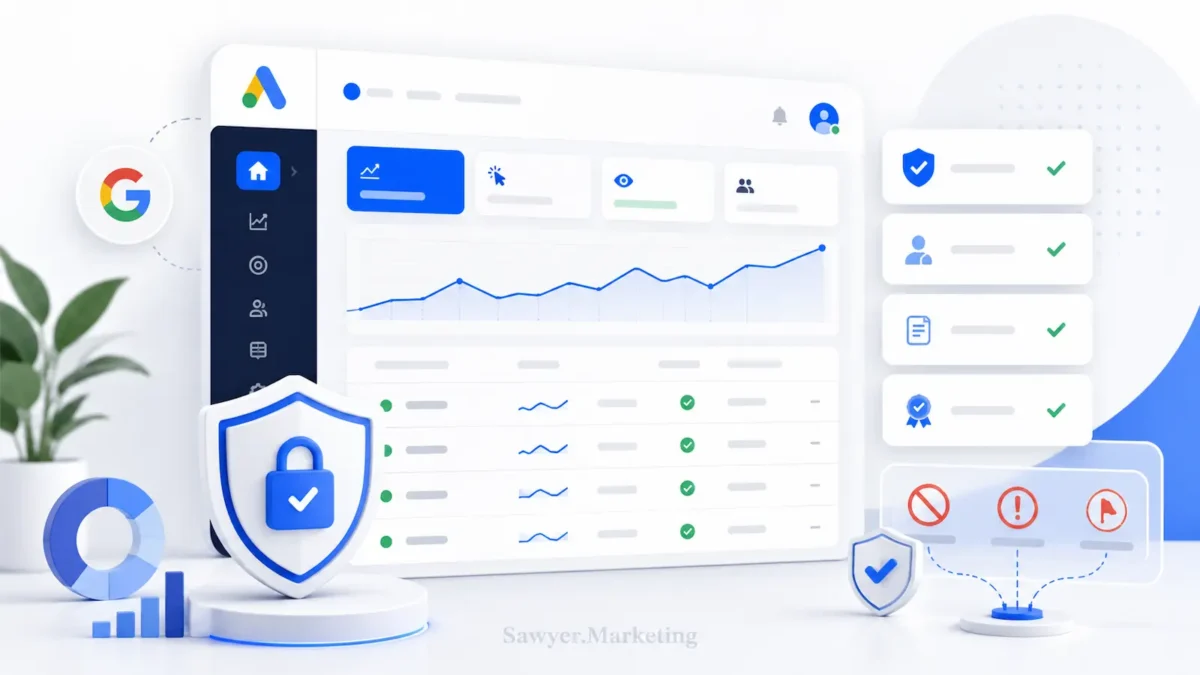
In 2025–2026, Google Ads has become much stricter about advertiser quality. The system evaluates not only ads, but also the website, business model, payment data, account history, company transparency, user behavior, and even indirect trust signals. In other words, it is no longer enough to simply write “buy a service” and set a budget.
For medium and large businesses, an advertising account suspension is an operational risk. Especially if Google Ads is one of the main sources of leads, sales, or B2B opportunities. At the moment of suspension, no beautiful ROAS in a report matters. No traffic means no funnel.
In this article, we will break down how to protect a Google Ads account from suspensions and restrictions: from advertiser verification and website policies to payment discipline, account structure, risky niches, and actions that are better not to take even “as a test.”
Why Google Ads suspension has become a critical risk for business
Google has long stopped being just an ad cabinet where you can quickly launch a campaign, get clicks, and optimize bids. Today it is an ecosystem of trust. The platform wants to understand who is advertising, what exactly they are selling, whether it is described honestly on the website, whether the ad misleads the user, and whether the business is trying to bypass previous restrictions.
And that makes sense. The advertising market is overloaded with pseudo-experts, financial schemes, fake brands, aggressive landing pages, doorway pages, questionable offers, and companies that create a new account every time the old one gets banned. Google responds with automation, checks, and strict policy signals.
For business, this means one simple thing: Google Ads must be managed as infrastructure, not as a set of campaigns. Just as accounting cannot work “by eye,” an advertising account should not exist without rules, responsible people, a change log, and risk checks.
Main reasons for Google Ads suspensions and restrictions
A suspension rarely happens because of one random click. More often, it is an accumulation of signals that the system interprets as risk. Below are the key areas where businesses most often plant a mine under themselves.
Misrepresentation
Non-transparent company information, exaggerated promises, hidden terms, inconsistencies between the ad and the website, and no clear understanding of who exactly provides the service.
Circumventing systems
Attempts to bypass rules: new accounts after a ban, domain substitution, cloaking, landing page manipulation, and repeated promotion of prohibited content.
Billing issues
Payment problems, suspicious payment methods, different owners of cards and accounts, frequent payment declines, and mismatched billing and business countries.
1. Non-transparent website
A website without a contact page, privacy policy, terms of service, company information, and a clear product description is a weak trust signal. This is especially true if you work in niches with increased scrutiny: finance, medicine, law, education, crypto, investments, nutraceuticals, insurance, or employment.
2. Inconsistencies between business, website, and documents
One name in Google Ads, another in documents, a third on the website, and a fourth in the payment profile is a classic recipe for problems. The system does not like it when an advertiser looks like a nesting doll made of different legal entities, brands, and domains without explanation.
3. Aggressive promises in ads
“Guaranteed result,” “100% approval,” “risk-free income,” “permanent cure,” “instant solution to the problem” — such wording can trigger not only ad disapprovals, but also a deeper account review. In 2025–2026, sober expertise works better than loud performance circus.
4. Attempting to quickly bypass a ban
The worst thing you can do after a suspension is create a new account, attach another card, slightly change the domain, and launch again. For Google, this is not a “fresh start,” but a sign of system circumvention. After that, restoring normal work can become much more difficult.
Advertiser verification: what to prepare in advance
Advertiser verification is one of the key elements of account security. Google may ask you to verify identity, company, business operations, or documents. If verification is not completed on time, the account may be suspended or limited in serving.
Sawyer Marketing rule
Verification is not something you pass “when things get hot.” It is prepared before launch or immediately after creating the advertising infrastructure. The bigger the budget and the more complex the niche, the earlier you need to put documents, access, and public business information in order.
What must match
- company name in documents, the ad account, payment profile, and website;
- business registration country and payment profile country;
- contact information on the website and in the account;
- a domain that actually belongs to or is controlled by the company;
- business activity description in documents and the service actually being advertised;
- the brand under which the user sees the ad.
Documents and data worth keeping at hand
| What to check | Why it is needed | Typical risk |
|---|---|---|
| Legal company name | Advertiser verification | The website name does not match the documents |
| Address and contacts | Transparency for the user | The website has only a form without any business details |
| Payment profile | Financial trust | A personal card is used for a company account without explanation |
| Domain and brand | Connection between advertising and business | One brand is advertised, while another appears on the website |
A separate tip: do not submit documents in a hurry. A mistake in the name, an unreadable file, an outdated document, or an unsuitable country can create a problem where there was none. For Google, an inaccuracy in verification is not a “small detail,” but a potential risk signal.
Website, trust, and compliance with Google Ads policies
A landing page is not just the place where the click goes. For Google, it is proof that the advertiser is honest, clear, and not hiding important information. A weak website can break even a perfectly configured campaign.
Minimum set of trust pages
- Contacts: address, email, phone, form, messengers, preferably legal information.
- About the company: who you are, what you do, who you work for, and why you can be trusted.
- Privacy policy: especially if you collect leads, phone numbers, emails, or use analytics.
- Terms of service: what exactly the client receives, what limitations exist, and how interaction works.
- Returns or cancellations: if you sell products, subscriptions, training, consultations, or digital products.
- Transparent product description: without hidden payments, exaggerations, or “magical” guarantees.
What is especially important for 2025–2026
Google is getting better at seeing the gap between the advertising promise and the actual page. If an ad talks about an official service, while the website looks like an intermediary without explaining its status, that is a risk. If the ad promises a quick solution, while the site has no terms, qualifications, limitations, or legal information, that is also a risk.
Mini-audit of the landing page before launch
- Is it clear within 5 seconds who provides the service?
- Does the brand name match the ad?
- Are contacts, privacy policy, and terms available?
- Are there any inflated guarantees or manipulative promises?
- Do all buttons, forms, menus, and the mobile version work?
- Does the website lead to broken pages, redirects, or suspicious external domains?
- Does the content match the real business model?
Payments, access, and account structure: technical hygiene that is often ignored
Google Ads suspension is often seen as a problem with texts or policies. But the payment and organizational side is just as important. If the account looks unstable in terms of payments, ownership, and access, the system may restrict it even without an obvious problem in the ads.
Payment discipline
- use a payment method that matches the business and account country;
- do not change cards chaotically without need;
- avoid regular payment declines;
- monitor card limits and balance;
- do not use questionable virtual cards for serious business accounts;
- keep access to the email linked to the payment profile.
Account access
In large teams, access often turns into a graveyard of former contractors, marketers, freelancers, and agencies. This is bad both for security and for manageability.
- keep access only for those who actually work with the account;
- do not share login and password instead of proper access;
- use different permission levels: admin, standard, read-only;
- enable two-factor authentication for key users;
- check change history after adding new specialists;
- do not give access to unclear “helpers” who promise account recovery in one day.
Account structure
If a business works with several brands, countries, or legal entities, the structure must be planned in advance. One chaotic account for everything is not always the best solution. But creating dozens of accounts without logic is a direct path to suspicion.
The optimal structure depends on the legal model, domains, payment profiles, languages, regions, and team responsibility. For medium and large businesses, using an MCC is often appropriate, but with clear logic: who owns it, which accounts are responsible for what, which domains are advertised, and which payment profiles are used.
Safe Google Ads campaign launch checklist
Before launching a new campaign, it is important to check not only keywords, budgets, and conversions. A policy audit should be part of the standard process. This is not bureaucracy. It is insurance against expensive downtime.
Before launch
- check the page for consistency with the advertising promise;
- remove aggressive guarantees and manipulative wording;
- check policies, contacts, terms, and privacy;
- make sure the domain opens without errors;
- check the mobile version and page speed.
Inside the campaign
- do not launch questionable offers “as a test” in the main account;
- do not mix different business models in one campaign;
- align keywords, ads, assets, and landing page;
- do not use other brands without legal grounds;
- check policy status after moderation.
Working tips from practice
- Launch new risky directions gradually. Do not add a new domain, new card, new niche, and large budget all in one day.
- Keep a change log. Record when the website, payment method, domain, campaign structure, texts, and tracking were changed.
- Do a pre-policy review. Before launch, let another person from the team check the page through the eyes of a moderator, not a marketer.
- Do not mask the problem with creative. If the service is risky, a beautiful banner will not save it. You need transparent packaging, documents, and correct wording.
- Synchronize SEO, PPC, and legal. What is written in organic content can also affect the perception of the website as an advertising destination.
Monitoring after launch: how to notice a problem before suspension
After launch, you cannot just look at CPA and ROAS. In Google Ads, you need to regularly check account quality signals: disapproved ads, warnings, verification status, serving limitations, changes in policy status, payment issues, and unusual drops in traffic.
| Signal | What it may mean | What to do |
|---|---|---|
| Sharp drop in impressions | Restriction, policy review, low trust, billing issue | Check campaign, ad, payment statuses, and account messages |
| Frequent ad disapprovals | Problem with texts, assets, or landing page | Fix the cause, do not duplicate the same ads without changes |
| Verification request | Google wants to verify the advertiser or business operations | Prepare documents, check data consistency, do not delay until the deadline |
| Policy warning | There is a risk of suspension if the violation is not resolved | Pause problematic elements, fix the website, and submit a proper appeal |
What to do if the account is already restricted
The first rule is not to panic and not to create a new account. The second is not to submit an appeal saying “we did not violate anything, unblock us.” Such an appeal explains almost nothing.
- read the exact reason in the Google Ads message;
- save screenshots of statuses, emails, and policy messages;
- check the website, ads, assets, payment profile, and documents;
- fix real problems before submitting an appeal;
- briefly explain in the appeal what exactly was fixed;
- do not submit many appeals in a row without new changes;
- do not try to bypass the suspension with new accounts.
Cases and practical scenarios
Case 1. A B2B company stopped scaling because of misrepresentation risk
Situation: the company sold a complex B2B service through a landing page that had strong promises but almost no legal information, cooperation terms, or explanation of who exactly provided the service.
What we did: rewrote the hero block, removed excessive guarantees, added an about page, privacy policy, working terms, cases, contacts, process description, and service limitations.
Result: campaigns passed moderation more stably, the number of disapprovals decreased, and the team gained a safer foundation for budget scaling.
Case 2. E-commerce received a restriction because of payment confusion
Situation: the store worked in several countries, but used different cards, different domains, and one advertising account without a transparent structure. After a series of declined payments, the account went under review.
What we did: cleaned up the payment profile, separated directions according to market logic, checked domain consistency, updated contacts, and removed unnecessary access.
Result: the business received a manageable advertising structure where each market has clear responsibility, and billing issue risks became lower.
Case 3. A company almost ruined its appeal because of haste
Situation: after suspension, the team wanted to immediately submit an appeal and create a backup account in parallel. This could have made the situation worse.
What we did: first audited the website, found inconsistent wording, updated documents, removed questionable claims, and prepared a short explanation of changes.
Result: the appeal became evidence-based, not emotional. This is exactly how policy risks should be handled: facts first, then the appeal.
Common mistakes that increase suspension risk
Below is a list of actions we regularly see in accounts that come in for audits. Some of them seem harmless. But in Google’s eyes, they may look like negligence or an attempt to bypass the rules.
- Creating a new account after the old one was suspended. This is one of the worst reactions, especially if the cause of suspension has not been fixed.
- Copying disapproved ads without changes. The system sees a repeated problem, not your persistence.
- Using different company names without explanation. The brand, legal entity, and payer must be logically connected.
- Ignoring trust pages on the website. Privacy, contacts, terms — these are not decoration, but basic hygiene.
- Giving all contractors administrator access. Later, no one knows who changed what and who is responsible for what.
- Launching risky offers in the main account. One “test” can put the entire business direction at risk.
- Writing generic phrases in an appeal. Google needs specific fixes, not resentment toward moderation.
- Not checking the website after technical changes. Redirects, errors, hidden blocks, broken forms, and new scripts can affect moderation.
FAQ: common questions about protecting a Google Ads account
Can anyone fully guarantee that a Google Ads account will not be suspended?
No. No agency or specialist can honestly guarantee the absence of suspensions, because the final decision is made by Google. But the risk can be significantly reduced: prepare documents, bring the website into compliance, set up payment hygiene, avoid grey mechanics, and respond quickly to warnings.
What should be done first if the account has already been suspended?
Do not create a new account and do not submit chaotic appeals. First, understand the reason, check the website, ads, billing, documents, access, and change history. After fixing the issues, submit a structured appeal with a brief explanation of what exactly was changed.
Does website quality affect Google Ads suspensions?
Yes. The website is part of the ad experience review. If it lacks contacts, terms, privacy policy, a clear service description, or contains exaggerated promises, this can increase the risk of disapprovals, restrictions, and deeper account review.
Is it safe to run several Google Ads accounts for one business?
Yes, if the structure has logic: different countries, brands, legal entities, or directions that are transparently connected to the business. It is dangerous to create new accounts to bypass suspensions, relaunch prohibited offers, or hide the real advertiser.
Should advertiser verification be prepared in advance?
If Google has already sent a request, you definitely should not delay. If the account is important to the business, it is worth preparing documents in advance and checking that names, addresses, domains, and payment data match. This reduces the risk of mistakes when the deadline is already close.
Can Sawyer Marketing help with a suspension risk audit?
Yes. We can review the advertising account, website, campaign structure, access, payment risks, ad texts, and compliance with basic Google Ads policies. The goal is not simply to “launch ads,” but to make the system stable for scaling.
Conclusion: protecting a Google Ads account is not a one-time check, but an operating system
A Google Ads suspension is rarely random. Most often, it is the result of weak preparation: a non-transparent website, chaotic access, payment confusion, aggressive promises, inconsistent documents, or attempts to bypass rules instead of fixing the problem.
In 2025–2026, the winners are not those who “upload campaigns” faster, but those who build advertising infrastructure with a safety margin. Google Ads likes transparent advertisers, clear websites, clean data, stable payments, and adequate communication. This may not sound as sexy as a “secret ROAS 10x strategy,” but it is exactly what allows you to scale without unnecessary drama.
If your business depends on paid traffic, do not wait for the first warning. Run an audit now: check the website, documents, account, billing, verification, access, and risky wording. In performance marketing, prevention is almost always cheaper than a fire.
Want to achieve a similar result?
The Sawyer Marketing team will check your Google Ads account, website, and advertising structure, find weak points, and help reduce the risk of suspensions before scaling.