
In 2026, the question “what is better: Lead Ads or messages in Messenger / WhatsApp?” sounds a little naive. As if a business is choosing between two buttons in Ads Manager. In reality, it is choosing between two different sales scenarios: collect contact details quickly or start a conversation immediately.
And this is where things get interesting. Lead Ads often generate cheaper leads, but managers then complain: “people do not respond,” “they do not remember leaving a request,” “the number is inactive,” “there is a lot of junk.” Messengers and WhatsApp may cost more at the start, but they more often bring a person into a live contact where you can ask clarifying questions, handle objections, and avoid waiting until the lead goes cold.
In this article, we will break down where each format wins, how to set them up correctly, how not to drown in cheap but empty leads, and why in strong performance systems Lead Ads and messengers often do not compete, but work together.
Why the question became critical in 2025–2026
The lead generation market in Meta Ads has changed significantly. Algorithms have become better at working with quality signals, CRM data, lower-funnel events, automated campaigns, and AI optimization. But along with that, the cost of mistakes has increased. If earlier you could simply launch a form, collect a hundred leads, and “somehow call them,” today this approach quickly burns through the budget.
The problem is not that Lead Ads are bad. And it is not that WhatsApp or Messenger magically sell better. The problem is that most businesses choose the format not for the real sales process, but by the principle: “where the lead is cheaper.” This is a dangerous trap.
Key idea: CPL does not show the effectiveness of lead generation. It only shows the cost of getting a contact or starting a dialogue. A business needs not just leads, but qualified sales opportunities: consultations, bookings, meetings, invoices, and deals.
In 2025–2026, strong advertising systems look deeper:
- how many leads responded after the first contact;
- what percentage of leads became qualified;
- how many people reached a call, consultation, or meeting;
- what the CPL is specifically for quality leads, not for everyone in bulk;
- what the CAC, ROAS, or ROMI is after the sale;
- how quickly managers process the lead;
- whether CRM data is sent back into the advertising system.
What the difference is between Lead Ads, Messenger, and WhatsApp
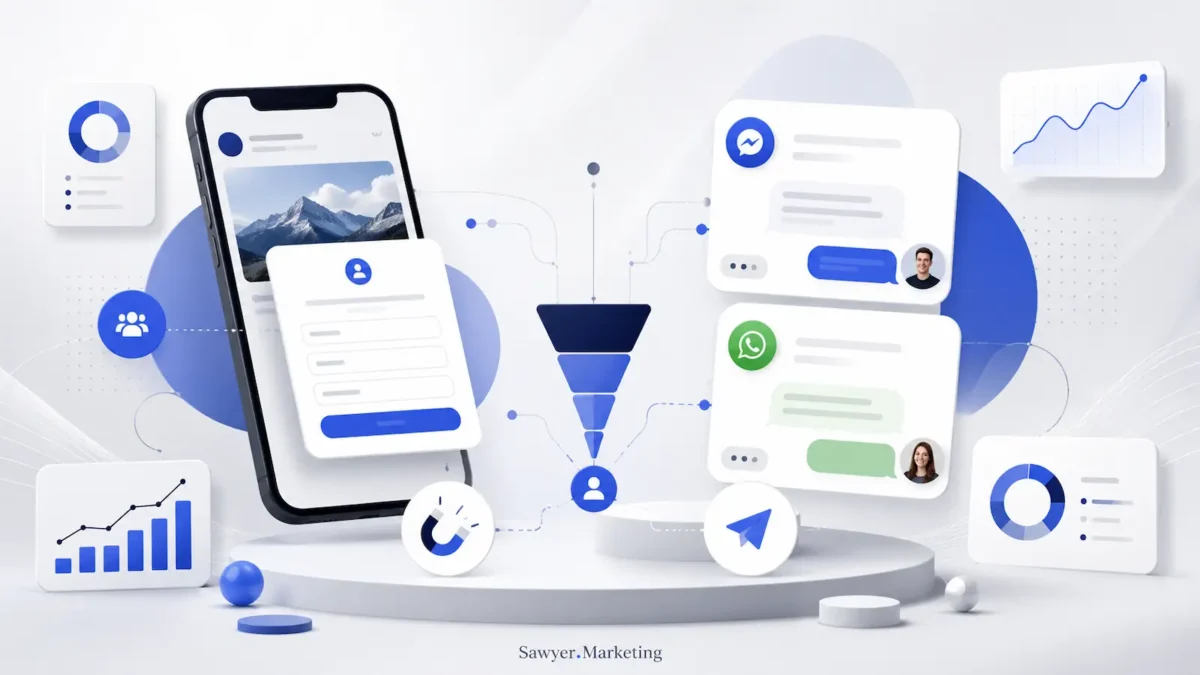
On the surface, everything is simple: Lead Ads collect data through an instant form, while Messenger and WhatsApp move the user into a dialogue. But for a performance marketer, these are three different types of intent.
Lead Ads: contact before conversation
Lead Ads, or Instant Forms, work inside Facebook and Instagram. A person clicks on an ad, sees a form, some fields may be prefilled automatically, they confirm the data — and the business receives a lead.
The strong side of forms is minimal friction. The user does not need to open a website, wait for it to load, switch to a messenger, or write the first message. Because of this, Lead Ads often generate a large volume of leads and a lower cost per lead.
The weak side is the low action threshold. If the form is too simple, people submit a request almost impulsively. For mass-market segments, this is a plus; for expensive products, it is a risk.
Messenger: dialogue with context
Messenger works well where you need to ask several questions before the sale, explain the difference between packages, clarify the need, or quickly hand the person over to a manager. This is not just a lead. It is the beginning of a conversation.
The format is especially useful for services, local businesses, consultative sales, education, real estate, automotive, medicine, B2C services, and products where the person wants to “ask first.”
WhatsApp: speed, trust, and contact on the phone
WhatsApp is often stronger where the audience is used to solving issues through a phone messenger: services, international markets, premium consultations, logistics, medicine, tourism, B2B communication, and sales through a manager.
The user opens a chat in a familiar app. For many people, this feels psychologically closer to real contact than filling out a form. But there is a nuance: if the business does not respond quickly, the entire advantage of the format disappears.
Lead Ads
Best for quickly collecting contacts, testing offers, mass audiences, and retargeting.
Messenger
Best for consultations, clarifying needs, warming up, and scenarios with a live manager.
Best for fast personal contact, international markets, and sales where trust matters.
When Lead Ads work best
Lead Ads should be chosen when a business needs to quickly get a predictable flow of leads and has a system for processing them. Not “a manager will call back someday,” but a real system: CRM, SLA for contact speed, statuses, scripts, quality control, and sending results back into analytics.
Scenarios where Lead Ads often win
- Free consultations. For example, an ad audit, project evaluation, lawyer consultation, or solution selection.
- Lead magnets. Checklists, calculators, guides, demo access, presentations, webinars.
- Retargeting. When people have already visited the website, viewed services, or interacted with Instagram / Facebook.
- Mass B2C services. Salons, clinics, repair, education, local services, product selection.
- B2B with an upper funnel. When the first action is not a purchase, but a request for a consultation or materials.
How to improve lead quality in Lead Ads
The worst thing you can do with Lead Ads is set up a form with two fields and expect ideal clients to come from it. The algorithm will bring people who easily leave contact details. If you do not add filters, it will optimize toward quantity, not quality.
Working tips for Lead Ads
- Use a higher-intent form if the product is expensive or the sale is complex.
- Add 2–4 qualification questions: budget, timeline, service type, city, role in the company.
- Do not hide the price completely if it critically affects lead quality. It is better to filter out non-target users before a manager spends time on them.
- Write clear text on the confirmation screen: what happens next, when to expect contact, and what the next step is.
- Send leads to CRM automatically, without manual CSV exports and “we will import it tomorrow.”
- Create separate campaigns or ad sets for different intent levels: cold audience, warm retargeting, lookalike based on quality leads.
- Test not only creatives, but also the form structure. Sometimes one additional question reduces the number of leads but sharply increases sales.
At Sawyer Marketing, we often see a situation where after making the form more complex, CPL grows by 20–60%, but the cost of a qualified lead drops. For business, this is not a problem — it is a win. Cheap junk always looks beautiful in Ads Manager. It starts looking bad only in CRM.
When it is better to launch Messenger + WhatsApp
Messengers should be chosen when instant dialogue matters for the sale. A person does not want to “leave a request and wait.” They want to ask a question: how much it costs, whether the product suits them, when they can start, whether there are available slots, how the process works, what guarantees exist, and what documents are needed.
Where Messenger and WhatsApp are stronger than a form
- High ticket. When people do not buy after one banner and need trust and explanation.
- Complex product. When the offer needs to be adapted to the client’s request.
- Fast demand. Appointment, booking, consultation, urgent service, selection.
- International audience. In many countries, WhatsApp is the actual standard for business communication.
- Sales through a manager. If the manager is strong, the messenger allows them to join earlier.
How not to break the messenger funnel
Messenger advertising does not forgive slow reactions. If a person clicks on the ad, opens the chat, and gets silence, you have not just lost a lead. You have given a competitor the opportunity to answer faster.
That is why the minimum setup for Messenger + WhatsApp looks like this:
- automatic greeting with a clear question;
- quick replies or buttons for segmentation;
- a short qualification script;
- handover of the dialogue to a manager;
- response regulations during working hours;
- a backup scenario if the manager is not online;
- capturing the source, campaign, and status in CRM.
Sawyer Marketing practical principle
If a business is not ready to respond quickly in a messenger, it is better not to launch Messenger or WhatsApp as the main format. First, build the operational process, then scale advertising. Otherwise, the campaign will be “bad” only because the sales department works like a fax machine in 2007.
Comparison of formats for business
There is no universal winner. There is a format that better fits a specific funnel, product, audience, and sales speed. Below is a practical comparison without romanticism.
| Criterion | Lead Ads | Messenger | |
|---|---|---|---|
| Lead collection speed | Very high | Medium / high | Medium / high |
| First contact quality | Depends on the form | Higher through dialogue | Higher through personal contact |
| User action threshold | Low | Medium | Medium |
| Risk of low-quality leads | Higher without filters | Lower with the right script | Lower with a fast response |
| Suitable for complex sales | Yes, but through qualification | Yes | Yes |
| Dependence on managers | Medium | High | High |
| Scaling | Strong | Strong with automation | Strong with systematic processing |
In short: Lead Ads are better for volume and a controlled form. Messenger and WhatsApp are better for dialogue, trust, and quick need clarification. But in real performance marketing, the strongest results often come not from choosing “either-or,” but from a smart combination.
Practical launch framework
Below is a framework that can be adapted for most businesses using Meta Ads. It does not replace strategy, but it clearly shows the launch logic.
Stage 1. Segment audiences by temperature
- Cold audience: interests, broad targeting, Advantage+ audiences, lookalike based on customers or quality leads.
- Warm audience: website visitors, Instagram / Facebook interactions, video views, form opens, people who previously messaged.
- Hot audience: those who visited key pages, started a form, opened a chat, but did not complete the action.
Stage 2. Match the format to intent
- For a cold audience — test Lead Ads with qualification questions and separately test Messenger / WhatsApp with an easy entry into dialogue.
- For a warm audience — Lead Ads with a specific offer or WhatsApp for fast contact.
- For a hot audience — messengers, remarketing, personalized creatives, “only a few details left to clarify.”
Stage 3. Do not mix all offers into one campaign
One of the typical mistakes is launching a consultation, price list, webinar, catalog, appointment, and “learn more” in one campaign. The algorithm is not a telepath. If offers have different levels of intent, they need to be separated or at least tested in a structured way.
Stage 4. Prepare creatives for the format
A creative for Lead Ads should quickly explain the value of the request: what the person will receive after filling out the form. A creative for WhatsApp or Messenger should provoke a dialogue: “Message us and we will help you choose an option,” “We will send a calculation,” “Ask a specialist a question.”
For Lead Ads
Clear offers, a specific result, a simple path, and a qualification form without unnecessary bureaucracy work well.
For Messenger / WhatsApp
Questions, situational creatives, a promise of a quick response, personal selection, and live expertise work well.
Analytics, CRM, and lead quality
Without analytics, choosing between Lead Ads and messengers turns into guessing. In Ads Manager, Lead Ads may win; in CRM, WhatsApp may win; and by profit, Messenger retargeting may win overall. That is why you should evaluate not the format, but the entire path from click to sale.
What needs to be tracked
- spend by campaign, ad set, creative, and placement;
- number of leads or started dialogues;
- cost per lead / dialogue;
- response rate after the first contact;
- share of qualified leads;
- number of consultations, calls, meetings, invoices;
- sales, revenue, margin, ROMI;
- reasons for rejection and statuses in CRM.
Why CRM integration is critical
If Meta sees only the fact that “a lead was created,” it optimizes for people who create leads. But the business needs people who buy or at least become quality sales opportunities. That is why in 2025–2026 CRM data, status transfer, offline conversion imports, Conversions API for CRM, and proper funnel discipline are especially important.
In other words, the advertising system should receive not only the signal “form submitted,” but also “lead qualified,” “consultation took place,” “deal created,” “deal won.” Then the algorithm gets a chance to learn from business value, not random clicks.
Lifehack: create separate CRM statuses for Lead Ads, Messenger, and WhatsApp. After 2–4 weeks, you will see not just the difference in CPL, but the real difference in quality, processing speed, and conversion into sale.
Cases and examples
Example 1. Educational project with an average ticket
The business was launching courses for professionals. Initially, they used Lead Ads with a very short form: name, phone, email. CPL was pleasant, but the sales department complained about weak lead motivation.
What was changed:
- questions about experience, learning goal, and desired start were added;
- Messenger was launched separately for those who wanted to ask a question before payment;
- retargeting was created for people who opened the form but did not submit it;
- the statuses “qualified” and “payment” were sent back into analytics.
Result: the number of cheap leads decreased, but sales became more stable. Lead Ads started working as the upper layer of the funnel, while Messenger became a channel for handling objections.
Example 2. High-ticket services
The company sold a complex B2B service. Lead Ads generated many leads, but some contacts did not respond, and some were too early in the decision-making process.
What worked better:
- creatives with specific pain points of executives;
- WhatsApp as the main channel for first contact;
- a short qualification script in chat;
- handover of the dialogue to a senior manager, not a general operator;
- retargeting to service page visitors through Lead Ads with the offer “get a project evaluation.”
In this case, WhatsApp won not because it is “better than forms,” but because the product required trust and a fast expert dialogue.
Example 3. Local service with fast demand
For a local service where the client wants to quickly book an appointment or check available time slots, Messenger showed strong results. Lead Ads collected contacts, but some people had already found an alternative by the time of the call.
The solution was a hybrid framework: Messenger for hot creatives with the call to action “message us and we will find a time,” and Lead Ads for retargeting and audiences that were not yet ready for direct dialogue.
Common mistakes
Now for the unpleasant part. Most problems with Lead Ads, Messenger, and WhatsApp happen not because of Meta, but because of weak campaign architecture and chaos in sales.
Mistake 1. Evaluating only CPL
A cheaper lead does not mean a better lead. You need to look at qualified CPL, cost per appointment, cost per sale, and ROMI.
Mistake 2. Making the form too simple
If the form does not filter the audience, it often collects people with low intent. There is volume, but no sales.
Mistake 3. Launching WhatsApp without a fast response
A messenger makes sense only when the business is ready to respond quickly and to the point.
Mistake 4. Not separating offers
A consultation, catalog, price list, and appointment are different intents. They cannot be thoughtlessly mixed into one logic.
Mistake 5. Not returning data to advertising
Without CRM statuses, the algorithm learns from surface-level actions, not from sales quality.
Mistake 6. One scenario for all audiences
Cold audiences, retargeting, and hot users need different messages and different levels of directness.
Format selection checklist
To avoid arguing at the “I think so” level, go through this checklist.
Choose Lead Ads if:
- you need a predictable volume of leads;
- the product can be explained briefly;
- you have CRM and fast contact processing;
- you can add qualification questions;
- you are testing offers, audiences, or lead magnets;
- it is important to scale campaigns with a controlled structure.
Choose Messenger or WhatsApp if:
- the client needs to ask a question before making a decision;
- the product is complex or expensive;
- the sale depends on the quality of the manager;
- the audience is used to communicating in messengers;
- response speed is a competitive advantage;
- you can automate the first steps of the dialogue.
Choose a hybrid framework if:
- you have several audience segments with different readiness levels;
- some people are ready to talk immediately, while others want to “receive materials”;
- you sell a complex product with a longer funnel;
- you need to test not only the channel, but also user intent;
- you have enough budget for a parallel format test.
FAQ: common questions about Lead Ads, Messenger, and WhatsApp
What is better for lead generation: Lead Ads or WhatsApp?
It depends on the product and the sales process. Lead Ads more often win in volume and speed of collecting contacts. WhatsApp is often stronger in complex or expensive sales where a live dialogue and fast manager response are needed.
Why do Lead Ads generate many low-quality leads?
Usually because the form is too simple, the offer is weak, there are no qualification questions, and optimization focuses only on the number of leads. If the form does not filter users, the algorithm quickly finds those who easily leave contact details, but do not necessarily buy.
Can Lead Ads and Messenger be launched at the same time?
Yes, and this is often the best option. Lead Ads can collect contacts and work with audiences that are not yet ready for dialogue. Messenger or WhatsApp can capture hotter users who need a quick consultation.
Which format is better for B2B?
For B2B, a hybrid often works: Lead Ads with qualification questions for structured data collection and WhatsApp or Messenger for warm audiences where personal contact is needed. It is important to evaluate not CPL, but lead quality and conversion into a meeting or deal.
Is CRM needed for such campaigns?
Yes, if you want to manage the result and not just look at beautiful numbers in Ads Manager. CRM allows you to see lead quality, processing speed, statuses, sales, and send valuable signals back into the advertising system.
What should you do if messenger ads generate few dialogues?
Check the offer, creative, first message, response speed, audience selection, and entry barrier into the dialogue. Often the problem is not in the format itself, but in the fact that the ad does not give the person a clear enough reason to message right now.
Conclusion: do not choose a format, choose a funnel
Lead Ads, Messenger, and WhatsApp are not three “buttons for leads.” They are three different ways to capture user intent. Lead Ads work better where contacts need to be collected quickly and systematically. Messenger helps where conversation, need clarification, and warming up matter. WhatsApp is strong in scenarios where contact must be personal, fast, and familiar to the client.
But the main thing is not the format. The main thing is strategy. If you do not have a proper offer, CRM, fast processing, analytics, and an understanding of lead quality, any format can turn into a budget vacuum cleaner. And vice versa: if the system is built correctly, Lead Ads and messengers can work together, strengthening each other.
At Sawyer Marketing, we look at lead generation not as “make it cheaper.” We look at it as a performance system: from creative and audience to CRM, analytics, qualification, and real sales. Because business does not need leads in a spreadsheet. Business needs clients.
In short: what to do right now
- Compare formats not by CPL, but by the cost of a quality lead and sale.
- For Lead Ads, add qualification questions and CRM integration.
- For Messenger and WhatsApp, prepare a dialogue script and fast response.
- Separate cold, warm, and hot audiences.
- Test a hybrid framework if the product is complex or the ticket is high.
Want to achieve a similar result?
Sawyer Marketing will help choose the right combination of Lead Ads, Messenger, and WhatsApp, set up analytics, CRM signals, and campaigns that work not for a beautiful CPL, but for sales.