

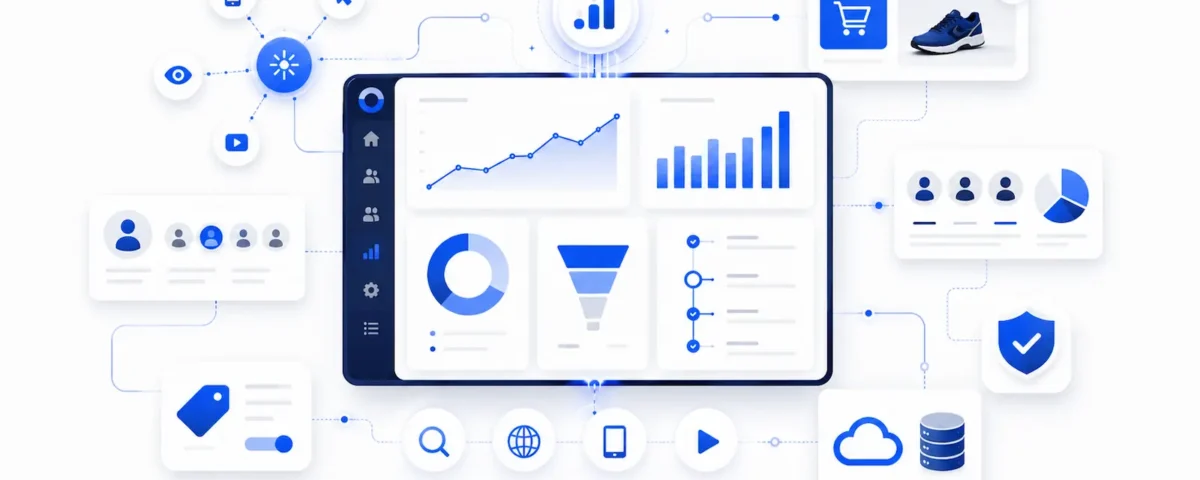
GA4 is often perceived as inconvenient analytics where “everything is different from before.” And this is partly true. If you approach Google Analytics 4 as Universal Analytics with a new interface, it will be painful: familiar reports have disappeared, conversions are now called key events, sessions are counted differently, and events have become the center of the entire system.
But if GA4 is configured correctly, it turns from a strange set of charts into a proper performance system: you see where users come from, what they do on the website, which sources actually generate leads or sales, where the funnel drops, which audiences should be brought back through advertising, and which campaigns deserve scaling.
The problem for most businesses is not that GA4 is “bad.” The problem is that it was installed as a traffic counter, not as a business-result measurement system. As a result, the account has traffic, charts, and some events, but no answer to the main question: what actually brings money?
In this guide, we will break down GA4 from basic setup to advanced level: account structure, events, key events, ecommerce, GTM, audiences, Google Ads, Consent Mode, BigQuery, CRM data, common mistakes, and a practical checklist.
What GA4 is and why it is different
Google Analytics 4 is modern event-based analytics for websites and apps. While Universal Analytics was built around sessions, pages, and hits, GA4 looks at user behavior through events. A page view, click, scroll, product view, add to cart, lead, and purchase are all events.
That is why GA4 should not be configured “from memory.” It is important to think in advance about which user actions have business value, which events should be collected automatically, which are better sent through Google Tag Manager, and which should be configured at the code or ecommerce platform level.
Why GA4 matters for performance marketing
For a performance team, GA4 is not decorative analytics for a monthly report. It is a source of decisions. Through GA4, you can evaluate advertising channels, check traffic quality, analyze the path to a lead or purchase, build audiences for Google Ads, and see exactly where users drop out of the funnel.
If GA4 is configured poorly, advertising decisions become blind. Campaigns may look successful in the ad account but not be confirmed by website behavior, CRM data, or actual sales. That is why proper GA4 setup is not a technical detail, but a foundation for paid traffic, SEO, CRO, and marketing management.
Basic GA4 setup from scratch
You should start not with the “create property” button, but with measurement logic. Before installing GA4, it is worth answering several questions: what goals does the website have, which actions are valuable, which advertising channels are used, whether ecommerce is present, whether Google Ads integration is needed, whether a cookie banner is used, and whether data needs to be sent to CRM or BigQuery.
Step 1. Create a GA4 property
In Google Analytics, you need to create an account or use an existing one, add a GA4 property, specify the time zone, currency, and basic business information. It is important to choose the correct currency right away if you plan ecommerce or revenue analytics. Retroactive changes will not fix historical data.
Step 2. Create a data stream
For a website, a Web data stream is created. In it, you receive a Measurement ID, which is used to install GA4 through Google Tag Manager, Google tag, or directly in the code. For most businesses, Google Tag Manager is the most convenient option because it allows you to manage events without constant developer involvement.
Step 3. Check Enhanced measurement
GA4 includes automatic enhanced measurement: page views, scrolls, outbound clicks, site search, video engagement, file downloads, and form interactions. This is a useful base, but it should not be treated as full analytics. For example, automatic form interactions do not always correctly distinguish a real lead from technical interaction with a form.
| Element | What to check | Why it matters |
|---|---|---|
| Time zone | Matches the business’s main market | Otherwise, daily and campaign reports will be shifted |
| Currency | Matches financial analytics | Required for revenue, ROAS, and ecommerce |
| Data stream | GA4 is installed on all required pages | Without full coverage, data will be incomplete |
| Internal traffic | Office, contractors, and test visits are excluded | So behavioral data is not distorted |
| Referral exclusions | Payment systems, CRM, and technical domains are excluded | So sales sources are not overwritten |
Google Tag Manager and events: how not to create chaos
Google Tag Manager is the main tool for flexible GA4 setup. Through GTM, you can install the basic GA4 tag, configure clicks, forms, scrolls, views of important blocks, button interactions, ecommerce events, and parameter transfer.
But GTM can easily turn into chaos. If every specialist adds tags without naming conventions, documentation, and checks, after a few months no one understands which events work, which are duplicated, and which are no longer needed.
Which events should be configured
- generate_lead: successful submission of a lead form, not just a button click.
- click_phone: click on a phone number, especially for mobile traffic.
- click_email: click on an email or contact link.
- click_messenger: transition to Telegram, WhatsApp, Viber, or another messenger.
- view_service: view of a key service page.
- form_start: start of form completion, if it matters for the funnel.
- file_download: download of a commercial offer, price list, presentation, or PDF.
- purchase: successful purchase with value, currency, and item parameters passed.
Naming convention: a small thing that saves analytics
Event names should be clear, stable, and consistent across the entire system. Avoid creating events like “button1,” “form_new,” “lead_test,” or “send_form_2.” A month later, no one will remember what they mean.
It is better to use the logic: action + object + clarification. For example: click_phone_header, click_messenger_footer, submit_lead_form, view_pricing_block, download_pdf_catalog. For standard ecommerce events, it is worth using GA4 recommended names: view_item, add_to_cart, begin_checkout, purchase.
Sawyer Marketing working tip
Before configuring GA4, we create an event map: event name, trigger, parameters, where it fires, whether it is a key event, and where it is used in reports or advertising. This takes time at the start, but later saves dozens of hours during audits, ad scaling, and transferring the project to another specialist.
Key events: what to count as a conversion
In GA4, conversions are now called key events. These are events that are essential for the business: purchase, lead, call, booking, registration, subscription, download of an important file, or another action that genuinely moves the user toward value.
The most common mistake is marking everything as a key event. A button click, form opening, scroll, contact page view, messenger click, lead — everything becomes a “conversion.” As a result, the business sees nice numbers but does not understand what is actually valuable.
How to separate micro- and macro-conversions
| Action type | Examples | How to use it |
|---|---|---|
| Macro-conversion | Purchase, lead, booking, payment, registration | Main evaluation of marketing effectiveness |
| Micro-conversion | Phone click, form opening, price view, add to cart | Funnel and traffic quality analysis |
| Engagement signal | Scroll, video view, time on page, several pages viewed | Interest evaluation, but not the main business goal |
What to import into Google Ads
Not every key event should be imported as a primary conversion into Google Ads. If ad campaigns optimize for weak micro-events, Smart Bidding may start looking for people who click easily but do not buy or submit quality leads.
For primary optimization, it is better to use events as close as possible to the business result: purchase, generate_lead, qualified_lead, booked_call, or other confirmed actions. Micro-events can remain for analysis, audiences, and supporting reports.
Ecommerce analytics in GA4
For online stores, GA4 has separate ecommerce logic. It is important not only to see the fact of purchase, but to understand the entire journey: product view, list view, product selection, add to cart, checkout start, adding shipping or payment, purchase, and refund.
If ecommerce is configured correctly, you see not only sales, but also problem areas in the funnel. For example, many people view a product but do not add it to cart. Or they add it to cart but do not start checkout. Or they reach checkout but do not complete the purchase. This is no longer just analytics, but a map for CRO and ad optimization.
Key ecommerce events
view_item
The user viewed a product page. Helps analyze interest in specific products.
add_to_cart
The product was added to cart. An important intent signal, but not yet a purchase.
begin_checkout
Checkout started. Shows how many users move to the final stage.
add_payment_info
Adding or selecting a payment method. Useful for checkout issue analysis.
purchase
Successful purchase. Should pass value, currency, transaction_id, and item data.
refund
Refund. Helps avoid making the revenue picture look better than reality.
What must be passed in purchase
- transaction_id: to avoid duplicate purchases.
- value: revenue or order amount.
- currency: transaction currency.
- items: products in the order with item_id, item_name, price, and quantity.
- coupon: promo code, if used.
- shipping and tax: if this data matters for financial analytics.
Reports, Explorations, and working with data
The GA4 interface may seem less obvious than Universal Analytics, but it is more flexible. Standard reports provide a quick overview, while Explorations allow you to build your own breakdowns: funnels, segments, user paths, cohorts, tables, and comparisons.
Which reports to check regularly
- Acquisition: where users and sessions come from.
- Traffic acquisition: which channels, campaigns, and sources bring traffic.
- User acquisition: where new users came from.
- Engagement: how users interact with the website.
- Events: which events fire and how often.
- Key events: which sources lead to important actions.
- Monetization: revenue, purchases, products, ecommerce behavior.
- Landing pages: which entry pages generate results.
Explorations: when standard reports are not enough
Explorations are needed when you want to answer a specific question. For example: what path do users take before submitting a lead? Where do buyers drop out in checkout? Which landing pages generate the best leads? How does mobile traffic from a specific campaign behave? How do new users differ from returning users?
The most useful formats for business are funnel exploration, path exploration, free form, and segment overlap. They allow you to see not only “how many conversions there were,” but also why some users do not reach the result.
Audiences and Google Ads integration
One of GA4’s strongest features is audiences. You can create user segments based on behavior: visited a service page, added a product to cart, started checkout but did not buy, viewed a specific category, interacted with a form, returned several times, made a purchase, or belongs to a valuable segment.
After linking GA4 with Google Ads, these audiences can be used in advertising campaigns: remarketing, Performance Max, Search, YouTube, Demand Gen, and other formats. This is especially important when a business wants not just to buy cold traffic, but to work with different levels of user readiness.
Examples of useful audiences
Cart without purchase
Users who added a product to cart but did not complete the order. A classic audience for bringing users back.
Key service view
People who were interested in an important commercial page but did not submit a lead.
Valuable buyers
Users with high revenue or repeat purchases. Useful for lookalike-style logic and Customer Match.
Engaged users
Users who viewed several pages, spent more time, or interacted with important elements.
What GA4 and Google Ads linking provides
- Import of key events into Google Ads for campaign optimization.
- Transfer of audiences from GA4 to Google Ads.
- Deeper analysis of user behavior after the click.
- Comparison of ad campaigns not only by clicks, but by actions on the website.
- Remarketing based on real behavior, not just website visits.
Consent Mode, privacy, and data quality
In modern analytics, privacy cannot be ignored. Cookie banners, user consent, regional requirements, browser restrictions, and data modeling directly affect what you see in reports. Consent Mode allows you to send Google information about the user’s consent status, and tags adapt their behavior according to that status.
If Consent Mode is configured incorrectly, a business may lose part of its data, measure conversions incorrectly, or face issues with advertising tools. This is especially important for markets where user consent requirements are critical.
What needs to be checked
- Whether there is a cookie banner and whether it actually manages consent, not just displays a message.
- Whether consent signals are passed to Google Tag Manager and GA4.
- Whether advertising and analytics tags do not fire before the user makes a choice, if that contradicts your consent policy.
- Whether the implementation has been checked through Tag Assistant.
- Whether the team understands how consent affects reports, modeling, and advertising data.
Important nuance
Consent Mode is not a “legal checkbox” and not a replacement for a privacy policy. It is a technical mechanism that must be aligned with the real consent collection logic on the website. For legal wording, it is worth working with specialized professionals; for technical implementation, with an analyst or developer.
Advanced level: BigQuery, CRM, and server-side data
When basic analytics is already working, you can move to an advanced level. Here, GA4 becomes not just a tool for viewing reports, but part of the business’s data infrastructure.
BigQuery Export
BigQuery allows you to store raw GA4 data and build more flexible analytics: custom attribution models, complex segments, integration with CRM, financial data, ad spend, and BI systems. For medium and large businesses, this is often the next step after standard GA4 reports.
CRM and lead quality
For lead generation, it is critical to understand which leads became sales. GA4 can show generate_lead, but it does not know whether the lead was qualified, whether the manager responded, whether the deal happened, or what the sale amount was. That is why the ideal approach is to connect advertising and analytics data with CRM.
Server-side tracking
Server-side tracking helps better control data transfer, reduce dependence on browser restrictions, and improve measurement quality. But it is not a “magic pill.” Server-side tracking makes sense when basic events are already well thought out, consent logic is configured, and the business understands what data it sends and why.
Practical example
In a B2B project, ad campaigns looked stable by the number of leads, but sales were not growing. After auditing GA4 and CRM, it became clear that some campaigns were bringing cheap but low-quality leads. We separated events into lead and qualified_lead, configured quality transfer from CRM, changed the main optimization in Google Ads, and rebuilt the reports. As a result, marketing started evaluating not “the number of forms,” but real sales opportunities.
GA4 setup checklist
Base
- GA4 property has been created.
- Time zone and currency are set correctly.
- Web data stream has been created.
- GA4 is installed through GTM or Google tag.
- DebugView and Realtime have been checked.
Events
- There is an event map.
- Key user actions are configured.
- Events have clear names.
- Required parameters are passed.
- There is no event duplication.
Conversions
- Key events are marked only for truly valuable actions.
- Micro- and macro-conversions are separated.
- Google Ads receives the right goals.
- Lead or sales quality is checked.
- Events are tested after website changes.
Ecommerce
- view_item, add_to_cart, begin_checkout, and purchase are passed.
- Purchase has transaction_id, value, and currency.
- Item parameters are passed correctly.
- Payment systems do not overwrite sources.
- Revenue is checked against CMS or CRM.
Integrations
- GA4 is linked with Google Ads.
- Search Console is connected if needed.
- Remarketing audiences are created.
- Consent Mode is configured.
- BigQuery is connected for advanced tasks.
Quality control
- Internal traffic is excluded.
- UTM tags are checked.
- There are no unnecessary referral sources.
- There is documentation for tags and events.
- Regular audits are performed after website changes.
Common mistakes in GA4
GA4 does not forgive chaotic setup. Data may look plausible but be unusable for decision-making. And that is the most dangerous part: the team trusts numbers that are actually collected incorrectly.
Mistake 1. Installing GA4 and configuring nothing
The basic tag collects only part of the data. Without events, key events, ecommerce, and integrations, GA4 does not provide a full picture of business results.
Mistake 2. Treating button clicks as leads
A click on the “Submit” button does not always mean a successful form submission. It is better to track the actual successful submission or the appearance of a thank-you state.
Mistake 3. Marking everything as a key event
If every micro-action becomes a conversion, reports lose meaning. A business needs a hierarchy: what is primary, what is supporting, and what is simply engagement.
Mistake 4. Not checking purchase duplication
If purchase fires again when the thank-you page is refreshed or when the user returns, revenue will be inflated.
Mistake 5. Ignoring UTM tags
Poor UTM tags destroy campaign reports. This is especially painful for Meta Ads, email, Telegram, partner placements, and banner advertising.
Mistake 6. Not checking GA4 against CRM
GA4 shows website behavior, but it does not always know lead quality or the final deal status. For B2B and high-ticket services, CRM reconciliation is critical.
Conclusion: GA4 should be a decision-making system, not just a counter
Google Analytics 4 is a powerful tool, but its value depends on setup quality. If you simply install the tag and look at standard charts, GA4 will seem complicated and not very useful. But if you build a system of events, key events, ecommerce, audiences, integrations, and data validation, it becomes a foundation for performance marketing.
Properly configured GA4 helps you understand which channels really work, which campaigns bring quality traffic, where users drop out of the funnel, which pages need optimization, which audiences should be brought back with ads, and which decisions should be made based on data rather than intuition.
In 2026, it is no longer enough for a business to “have analytics.” It needs analytics that can be trusted. And this is where GA4 becomes not an expensive technical task, but a growth tool.
Want to achieve a similar result?
If GA4 is installed on your website, but you are not sure whether the data is correct, key events are configured properly, ecommerce is not duplicated, Google Ads receives quality goals, and reports actually help the business, it is worth starting with an audit.
The Sawyer Marketing team will help check the GA4 structure, Google Tag Manager, events, key events, ecommerce, UTM tags, Google Ads integration, Consent Mode, audiences, and data quality. We configure analytics not “for the sake of a checkbox,” but for decisions that affect advertising, sales, and profit.


